
Forensic AI that brings clarity and closure, faster.
Locarda unifies the disconnected processes of death investigation into a single end-to-end system of record—from intake through case closure.
If this excites you, we'd love to hear from you: founders@locarda.com
Proven in the field
Used across eight U.S. jurisdictions to support forensic professionals—and counting.
Locarda Companion
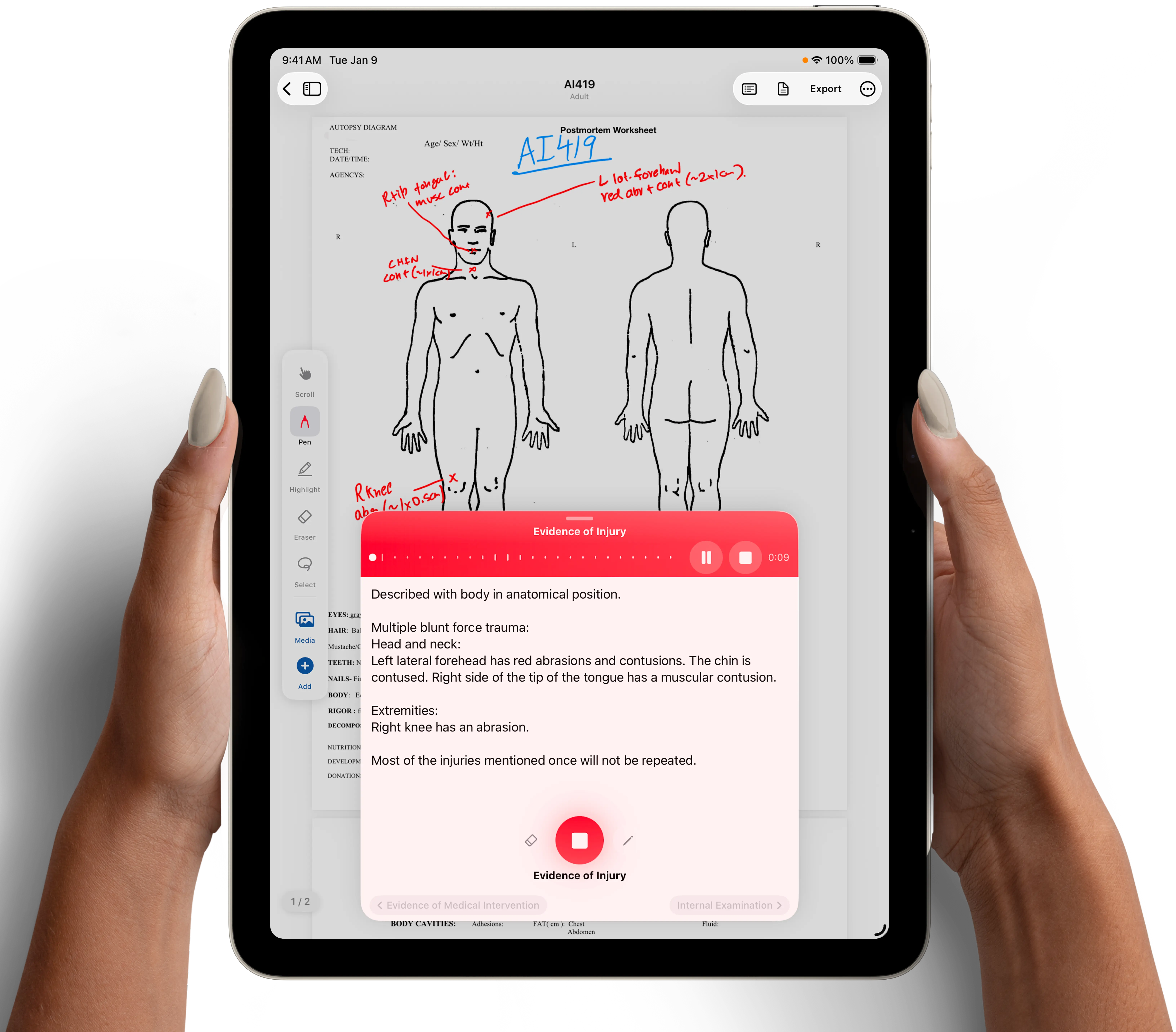
Hand it your template. Then just talk.
Locarda learns how you write. Your phrasing, your ordering, the habits you never had to explain. Then it writes that way inside the format your office requires.
-
Hand over your template
Drop in the .docx your office has used for years, plus a few of your own finished reports. Locarda picks up your personal phrasing on top of the office standard.
-
Pick it and start talking
Talk the way you already talk. Locarda quietly removes what does not belong in the report, then writes complete sentences in your format.
-
Check it, then export
A complete, editable Word document in your format. Companion reads it back against your dictation, flags conflicts like laterality, and asks you to confirm before export.
Every person gets their own preferences. The office keeps one standard.
- Section order25 sections
- Headings & spacingOffice standard
- Sentence styleThe way you write
uh heart’s about 420 grams, coronaries have mild narrowing, um no thrombosis, valves look fine.
liver, you know around 1650, capsule smooth, nothing focal, gallbladder’s fine.
lungs, left one’s 610 grams, heavy and congested, right is 480. uh wait—right one’s 610, left is 480. yeah the right lung is the heavy congested one, pleural surfaces smooth.
- Cardiovascular system The heart weighs 420 grams. The coronary arteries show mild atherosclerotic narrowing without thrombosis. The valves and chambers are unremarkable. No acute infarct is identified.
- Hepatobiliary system The liver weighs 1,650 grams. The capsule is smooth. The parenchyma is unremarkable, without focal lesions. The gallbladder is unremarkable.
- Respiratory system The left lung weighs 610 grams and is heavy and congested. The right lung weighs 480 grams. The pleural surfaces are smooth, without focal consolidation.
- Section order matches your template
- Every dictated weight is in the table
- Laterality conflict in Respiratory system
Confirm laterality
In dictation, 610 g was assigned to the left lung, then to the right lung. Which should the report use?
left lung … 610 g / right lung … 480 g
right lung … 610 g / left lung … 480 g
Confirm right lung 610 gResolved. Ready to export.
CARDIOVASCULAR SYSTEM
The heart weighs 420 grams. The coronary arteries show mild atherosclerotic narrowing without thrombosis. The valves and chambers are unremarkable. No acute infarct is identified.
RESPIRATORY SYSTEM
The left lung weighs 610 grams and is heavy and congested. The right lung weighs 480 grams.The right lung weighs 610 grams and is heavy and congested. The left lung weighs 480 grams. The pleural surfaces are smooth, without focal consolidation.
HEPATOBILIARY SYSTEM
The liver weighs 1,650 grams. The capsule is smooth. The parenchyma is unremarkable, without focal lesions. The gallbladder is unremarkable.
ORGAN WEIGHTS
| Heart | 420 g |
| Right lung | 610 g |
| Left lung | 480 g |
| Liver | 1,650 g |
Hand over your template: Drop in the .docx your office has used for years, plus a few finished reports.
Locarda Investigator
Walk the scene. Locarda writes it.
Gloves on, flashlight in the other hand. Speak what you see — and tell Locarda what to do. Narrative goes in the form. Commands like “take a picture” stay out of it.
-
Open your investigation form
Drop in the scene form your office already uses. Locarda maps narrative, postmortem, notification, and photo fields the way your county writes them.
-
Speak the scene — say “take a picture”
On your phone at the scene: talk what you see into the running narrative. Say “take a picture” when you need a photo — hands stay on the flashlight.
-
Check it, then take it with you
Companion reads the narrative back against what you said, catches slips, and proposes a fix. Approve it, then download the scene narrative or copy it all into your office system.
Locarda tells the difference between what you observed and what you asked it to do.
- Investigator narrativeCircumstances
- Postmortem & notifyOffice fields
- Scene photosAttached on scene
- Next of kin notified on scene at 0231 hours
- Identification confirmed by spouse
- Narrative matches your scene form
- Scene photo is attached
- Last-known-alive day may be off
Suggested edit
You said “Tuesday evening,” but earlier notes put last known alive on Monday.
last known alive Tuesday evening
last known alive Monday evening
ApproveApplied. Ready to export.
Investigator narrative
The decedent was located in the bedroom, lying supine on the bed. The reporting party, the decedent’s spouse, stated he was last known alive Tuesday eveninglast known alive Monday evening and had complained of chest pain that morning.
Postmortem changes
Livor mortis is posterior and fixed. Rigor mortis is full in all major muscle groups. No external evidence of trauma is observed.
Notification & disposition
- Next of kin notified on scene at 0231 hours
- Identification confirmed by spouse
- Remains released to contracted funeral home
Open your investigation form: Drop in the scene form your office already uses.
One platform. Every role, connected.
Investigators, forensic pathologists, surgical pathologists—built for the disciplines that connect.
Locarda Companion
A second set of eyes — from first call to final report.
Join offices that won't settle for less
County medical examiners and coroner offices are choosing tools built for them. We'd love to hear from you.